Short answer
Yes, artificial turf in open Texas sun can get far hotter than a lawn. In one Penn State trial, a synthetic sports-field product peaked at 155.7 degrees Fahrenheit beside unwatered ryegrass at 95.4. Watering cooled it only briefly, and Keller restricts daytime outdoor watering, so check the city's rule and plan for afternoon shade first.
Does artificial turf get hot in Texas? It does, so be wary of any product pitched as staying cool. Our artificial turf installation Keller TX page covers dog runs and play areas, and heat is the first thing we will bring up when we look at photos of your yard. Where the turf sits and how much shade it gets will likely matter more than any feature printed on a sample.
How much hotter does artificial turf get than grass?
One of the clearest measurements comes from Penn State's Center for Sports Surface Research. In a June 2015 trial in University Park, Pennsylvania, their synthetic turf irrigation study tested a synthetic sports-field product beside a plot of unwatered ryegrass. The synthetic plot peaked at 155.7 degrees Fahrenheit and the ryegrass topped out at 95.4 degrees, a gap of about 60 degrees on the same afternoon. The air temperature in the trial stayed in the 70s, nowhere near a Texas summer.
That was one trial on one sports-field product, and backyard turf is built differently, so treat those numbers as a guide to how far apart the two surfaces can get.
Keller's summers run a good deal hotter than that trial. The National Weather Service says the average first 100 degree day at DFW lands around July 1 and the last around August 27. We do not have a measured Keller surface reading to give you. Our rule of thumb is to treat exposed turf in full sun the way you already treat the pool deck.
What makes one turf install hotter than another?
Sun exposure is the big one. The Penn State report says surface temperature depends on weather, location and especially solar radiation, and it points to earlier work showing that a clear, sunny day with air around 80 degrees often produces hotter turf than a hazy, humid day that is warmer.
Among the things you get to choose, fiber color and infill are the usual talking points. Darker blades generally absorb more sun, and a lighter blend with a tan or brown thatch layer is often said to run a little cooler. We have no measured figure for how much, and you should expect a lighter blend to still feel hot in full sun.
Infill is the granular material brushed between the blades. Black crumb rubber, the kind often used on sports fields, is generally considered one of the hotter choices. Plain sand is a common alternative, and several coated or mineral infills are sold as cooler. Some of those claims may come from the seller's own tests, so ask what the comparison was before you pay extra for one.
Does hosing down artificial turf cool it off?
Only for a while. The Penn State team watered their plots by hand and the surface fell well below 100 degrees right away, and then it climbed back. The plot given about a tenth of an inch was above 120 degrees again within 45 minutes, and the plots given about three quarters of an inch took an hour and fifteen minutes to get there. Ninety minutes after the first watering, the watered plots were still up to 20 degrees cooler than the dry one, but all of them were back over 130 degrees.
A hose is also a poor answer to afternoon heat here for a simpler reason. The city's ban on outdoor watering runs from 10 a.m. to 6 p.m. year-round, even on allowed watering days, and those are the hours when turf is hottest. Check the city's current rule, and ask the city how it applies to a hand-held hose. If you rinse turf to clean it or take the edge off, plan on early morning or evening.
Where does turf belong on a Keller lot?
Walk your yard at three in the afternoon in August and watch where the shadows fall. The east side of the house, the shady side of a tall board fence and the ground under a mature live oak are usually out of the sun during the hottest part of the day. Those are your best bets for a dog run or a play area you want to use in summer.
Where there is no natural shade, you can add some. If your play area sits in open sun, a shade sail is worth pricing alongside the turf, and our page on Keller playground turf covers the rest of that job. Around a pool, turf tends to be most comfortable on the side the house shades in the afternoon, and the sunny side can stay deck or paving. Our Keller pool surround turf page has more on that. If your Southlake pool yard has an umbrella or a covered patio throwing shade on one edge, that is a good edge to start with.
We would steer you away from turf in the open, south-facing middle of a lawn that toddlers cross barefoot at midafternoon, and in a dog's only outdoor space when it has no shade. A tired patch of living grass in those spots is likely to stay cooler underfoot.
What makes summer turf easier to live with?
Timing helps a lot. Mornings and evenings tend to be the comfortable hours on sunny turf in July and August. The American Kennel Club's hot pavement advice quotes its chief veterinarian saying asphalt and artificial grass can get hot enough to burn a dog's paw pads, and it suggests walking in the early morning or evening. It also gives a simple check. If you cannot comfortably hold your hand on the surface for ten seconds, it is too hot for your dog's paws.
Beyond that, it helps to add a sail where the house does not shade and to consider a lighter blend where there will be bare feet. Those are all easier to sort out before the turf goes down. For what the turf itself typically costs, see our Keller artificial turf cost guide.
Frequently Asked Questions
How hot does artificial turf get on a 100 degree day in Keller?
We do not have a measured Keller figure. In one Penn State trial, a synthetic sports-field plot reached 155.7 degrees Fahrenheit with the air only in the 70s, so a 100 degree afternoon could plausibly run hotter. Expect open turf in full sun to be too hot for bare feet, and check it with your hand first.
Is artificial turf too hot for dogs in Texas?
In full afternoon sun during summer, it can be. The American Kennel Club's chief veterinarian lists artificial grass among surfaces that can burn paw pads. Putting a run where it gets afternoon shade and keeping summer bathroom trips to morning and evening should help, and a ten-second hand check tells you whether the surface is too hot.
Does lighter colored artificial turf stay cooler?
It may run a little cooler. Lighter blades with a tan thatch generally absorb less sun than a dark, uniform green, though we have no measured figure for the difference and it will still be hot in full sun. Shade from a tree, a fence, a sail or the house is likely to help more than color.
Can I put artificial turf in full sun in Keller at all?
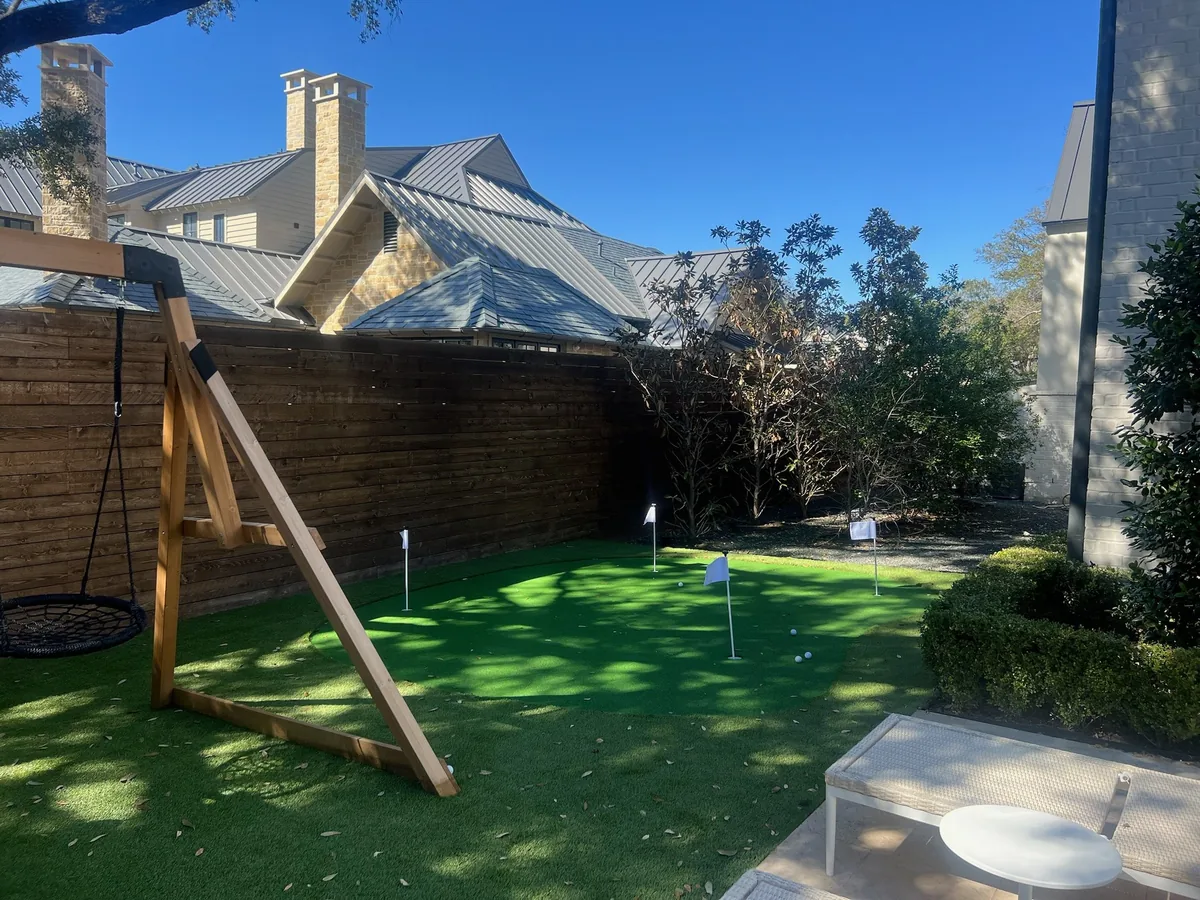
Yes, for the right use. A path, a side yard, a bocce lane or a putting green used in the evening can work in open sun. The zones worth keeping shaded are the ones used barefoot or by dogs during the hottest hours, which on most lots means the play area and the dog run.
Ready to Get Started in Keller?
Keller Artificial Turf Works serves Keller and the surrounding area. Send a few photos of your yard and we'll reply with a written quote.