Short answer
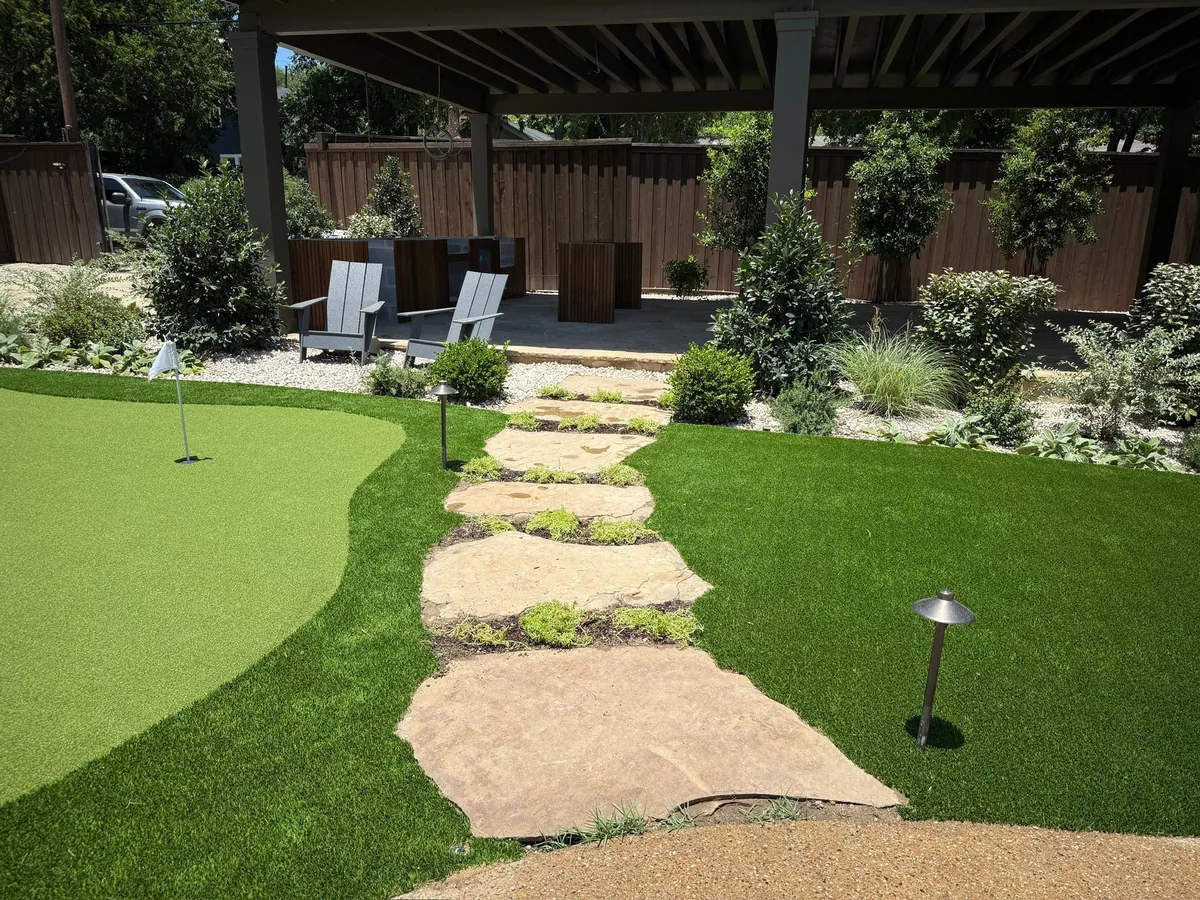
On a big Keller lot, turfing only the zones where grass keeps dying is often a better fit than turfing the whole backyard. Turf typically runs $10 to $12 a square foot installed, so by rough arithmetic a 180 square foot swing-set corner is about $1,800 to $2,160. Whole-yard turf can suit a small yard.
A partial artificial turf backyard makes sense when the trouble is a short list of patches that keep dying back: the dog's track along the fence, the bald ring under the swing set, the strip by the pool that gets splashed and trampled. Our artificial grass Keller TX page covers those spots, and on some yards the whole thing is the better call. Either way, it helps to start by working out which patches really are failing, since that decides what you end up paying for.
Which zones in a Keller yard take the beating?
Stand at the back door and look for the dirt. The dog run is the obvious one, usually a worn lane along the fence and a bare circle by the gate, and our page on Keller pet turf for dog runs covers that spot while the rest of the yard stays as it is. Under a playset, the swing arc and the slide landing rarely hold grass because feet keep dragging through the same two spots, and our Keller playground turf page covers that corner.
The pool strip tends to fail for a different reason. Splash, wet feet and shade from the house on one side can leave a band of grass that is half mud, and our Keller pool surround turf page covers replacing only that band. The shortcut from the patio to the gate is another one to check. Texas A&M's bermudagrass lawn calendar notes bermudagrass is not very shade tolerant, so a route along the north side of the house can lose grass to shade and feet at once. Our page on Keller artificial grass for paths shows how that strip can be finished.
How should partial turf meet the lawn and beds?
Most of how partial turf looks comes down to the edge, and a sloppy one can make the whole yard read as patched.
It helps to give the turf a natural place to stop. That could be a rectangle that follows the playset's footprint, a run held by the fence and a border, or a path that follows the beds. Freeform turf islands floating in the middle of a lawn are what people tend to picture when they say fake.
A solid edge is worth paying for. Steel or composite edging set flush, or a row of pavers, helps hold the line against the lawn and gives the mower wheel something to follow. Try to set the turf about level with the soil beside it, since a raised lip can catch the eye from across the yard, and ask your installer how they plan to finish the border.
When you look at samples, try to match the color to your own lawn. A Keller Bermuda lawn is often lighter and more olive than the deep emerald on many samples, and it goes straw colored in winter. A blend with mixed blade colors and a brown thatch layer tends to sit well beside a living lawn, and a single bright green tends to stand out.
What might two typical zones cost?
Say the swing-set corner measures 12 by 15 feet. That is 180 square feet. Turf around Keller typically runs $10 to $12 a square foot installed, so that corner works out to about $1,800 to $2,160 as rough arithmetic. Size, base prep and turf grade all move the final figure, and your written quote will have the real number.
Now the pool strip. A 5 foot band along 110 feet of coping is 550 square feet, or around $5,500 to $6,600 by the same rough arithmetic. Both zones together, 730 square feet, land somewhere near $7,300 to $8,760. A full 2,500 square foot backyard at the same rate would come to roughly $25,000 to $30,000. That gap is a good reason to start with the zones on a larger lot. Our Keller artificial turf cost guide walks through more sizes.
When does the whole yard make more sense?
A few situations point toward doing it all.
A small yard is the first. On a small lot, borders and transitions eat a big share of the space, and one surface can look cleaner than two or three zones with edging between them, though it will cost more than the zones alone.
Grass that fails nearly everywhere is the second. That might be heavy shade from a two-story house and mature trees, two large dogs with the run of the yard, or clay so compacted that Bermuda struggles to thicken up. If you are already re-sodding the whole yard, the cost comparison changes.
You may also simply be done with the sprinkler. The EPA's WaterSense program notes the average U.S. household uses more water outdoors than for showering and laundry combined. Taking a whole backyard off irrigation is a bigger change than taking a dog run off it, though turf may still need an occasional rinse. Confirm the city's current watering rules and your HOA's landscape guidelines before you commit.
If you love a green lawn in May, keep it. A big lot around Trophy Club can carry a healthy Bermuda lawn with two turf zones tucked where the grass has struggled.
Doing it in stages without regretting the first stage
If you start with one zone, decide now where the next one would go and set the first zone's edges so they can be extended later. A steel edge along the lawn side of a dog run can usually be pulled and moved, which is much harder with a mortared paver border. Keep a note of the product and infill so the second zone has a chance of matching, and take a photo of the base before the turf goes down. The first zone may end the re-sodding on its own, and the second then becomes a want more than a need.
Frequently Asked Questions
How small a turf zone is worth doing in a Keller backyard?
Any zone that fails as grass every year is worth pricing. A 100 square foot potty corner for a small dog or a 150 square foot slide landing would both be reasonable sizes. Below that, edging and setup can be a big share of the total, so extending to a natural boundary like the fence may be worthwhile.
Will a turf patch look fake next to my Bermuda lawn?
It may not, if the edge is deliberate and the color is close. Give the turf a boundary it is meant to fill, hold that edge with steel or pavers set flush, and look for a blend with mixed green tones and brown thatch. Keller Bermuda goes tan in winter, so choose with your lawn in view.
How much does a 180 square foot play corner cost to turf in Keller?
At the typical $10 to $12 a square foot installed, a 180 square foot corner comes to roughly $1,800 to $2,160 as rough arithmetic. Base work, the turf grade and awkward shapes can move the final figure, which we put in a written quote after seeing photos and rough measurements of the area.
Do we have to turf all the zones at once?
No. You could do the dog run this year and the play corner next spring. Plan the first zone's edges so they can be extended later, and keep a note of the product and infill so the next section has the best chance of matching. A good installer can help you plan the stages.
Ready to Get Started in Keller?
Keller Artificial Turf Works serves Keller and the surrounding area. Send a few photos of your yard and we'll reply with a written quote.