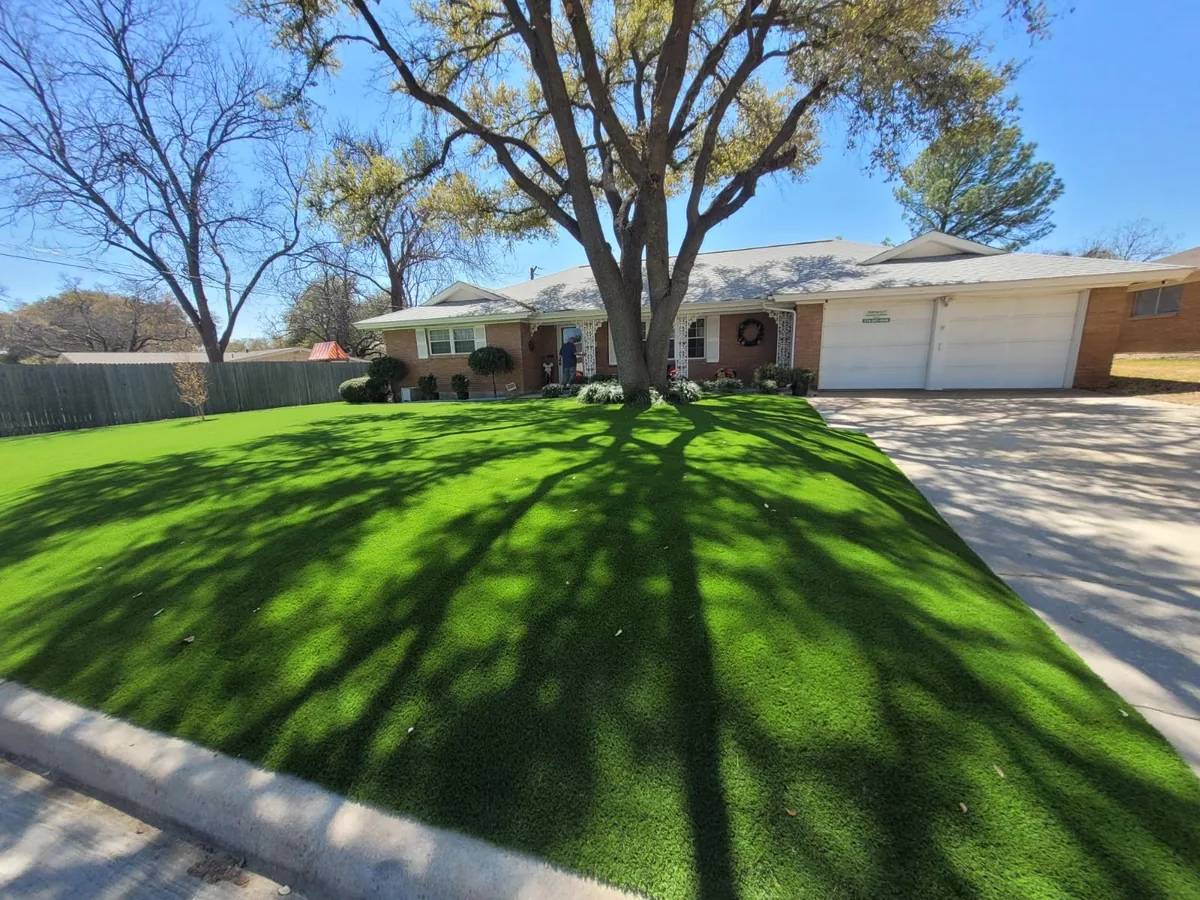
Short answer
Neither one wins everywhere in a Keller yard. Bermuda is usually the right call in open full sun, and Texas A&M describes it as very tolerant of drought and traffic. Artificial turf is worth pricing where Bermuda keeps failing, such as moderate to dense shade or a dog's daily path, at typically $10 to $12 a square foot installed.
Artificial turf vs bermuda grass has no single winner, and we say that as people who sell one side of it. Bermuda tends to fail in a few predictable places on a big North Texas lot, like the deep shade, the dog's path and the patch that has been re-sodded twice. Those are the spots where it may be worth looking at our low-water lawn North Texas page before you re-sod again. The shade, traffic, mowing and watering facts here come from Texas A&M AgriLife.
Ready to get a quote in Keller? Describe your yard and we'll reply.
Get a QuoteWhere does Bermuda grass do well?
Give Bermuda full sun and it is hard to beat. Texas A&M's Turfgrass Selection for Texas guide calls it very tolerant of drought and traffic, and the AgriLife bermudagrass home lawn calendar credits it with superior traffic tolerance and rapid recovery. Kids can tear across it all summer and it tends to fill back in, and a damaged spot patched with seed or sod in warm weather should knit in before long.
In full sun it is also likely to be much cooler underfoot than synthetic turf. Penn State researchers comparing a synthetic sports-field product with unwatered ryegrass in June sun found the grass far cooler, and we cover their numbers in our post on turf heat. That trial did not test Bermuda, though we would expect living Bermuda to stay cooler too. On an open, sunny lawn with no dogs and a working sprinkler system, Bermuda is likely the right call.
Where does Bermuda struggle on a Keller lot?
The biggest problem is shade. The same Texas A&M guide says bermudagrass requires full sunlight, and the lawn calendar says it is not very shade tolerant and may struggle in moderate to dense shade. Think of the north side of a two-story house, the ground under a mature live oak or the corner behind the shed. Bermuda tends to thin out there, and re-sodding rarely fixes it for long. St. Augustine, which A&M names as the most shade tolerant warm-season grass, is a living option if you want grass in those spots, though A&M warns it does not tolerate high traffic and can be killed by severe winters in the northern third of the state.
Dogs wear Bermuda down the same way, only faster. Bermuda recovers from traffic, but a dog running the same fence line every day can outpace that recovery, and urine can burn the spots it hits. Compacted clay can make both worse, and a lawn that puddles after a storm often has trouble thickening up.
Winter color is only cosmetic, but you will notice it. A&M notes warm-season grasses turn straw colored at the first frost and may go dormant during the winter. The National Weather Service puts the average first freeze at DFW around November 22 and the last around March 12, so a Keller Bermuda lawn can be tan for several months. Turf in a dog run or under a playset stays green through the winter.
How much water and mowing does each one need?
The AgriLife calendar recommends mowing Bermuda at 1 to 2 inches and says that often means weekly mowing through the growing season. Its guidance is one or two watering days a week depending on soil and slope, its worked example comes to about an inch a week, and it advises turning irrigation off or well down from late fall to early spring. Add fertilizer timing and weed control and it is a fair amount of work, or a monthly bill.
Turf needs none of that, though it does need a little upkeep of its own, like rinsing the dog run, brushing the play area where the fibers lie down, blowing leaves off in November and topping up infill now and then. Outdoor watering in Keller is banned from 10 a.m. to 6 p.m. year-round, so check the city's current rule and plan any rinsing for early morning or evening. You are trading mowing and watering for rinsing and brushing, and on most yards that is likely to take less time. Turf also has no way to cool itself the way living grass does by releasing water.
What does each one cost up front and over time?
Bermuda is cheap to put in. Seed or sod for a patch costs a small fraction of what turf does. Turf around Keller typically runs $10 to $12 a square foot installed, so a 350 square foot dog run comes to roughly $3,500 to $4,200 as rough arithmetic. Our turf cost guide for Keller has more sizes.
Then there are the ongoing costs. A Bermuda lawn keeps asking for water, mowing time or a mowing service and fertilizer, and the failing spots may need fresh sod each spring. Turf's upkeep tends to be small by comparison, mostly water for rinsing, an occasional bag of infill and your own time with a hose. How that balances depends on how much of your lawn is failing and what you pay for sod and mowing. We would not count on turf paying for itself, so weigh it on the mud, the mowing and the look of the yard.
So which one for your yard?
If a spot is sunny and open and the dogs stay off it, keep the Bermuda and water it on the city's schedule. If it is shaded, worn by dogs or has been re-sodded more than once, it is worth pricing turf there and leaving the lawn around it alone. For the shady north strip, see our Keller artificial grass for paths page, and for the fence line, our Keller pet turf for dog runs page. The open middle can stay grass.
A mixed yard like that can suit a big lot in North Richland Hills or Keller, and it looks planned. Grass is still the right surface for a lot of Keller lawns, and the parts that keep dying are the ones worth a second look.
Frequently Asked Questions
Is Bermuda grass a good lawn grass for Keller?
Yes, in full sun. Texas A&M describes bermudagrass as very tolerant of drought and traffic with rapid recovery, which suits an open North Texas backyard. It may struggle in moderate to dense shade, and heavy dog traffic and compacted clay can also be hard on it, so those parts of a Keller lot deserve a closer look.
How long does Bermuda grass stay brown in North Texas?
Warm-season grasses turn straw colored around the first frost, and the National Weather Service puts the average first freeze at DFW at about November 22. The average last freeze is around March 12. Expect a tan lawn for several months, with green-up varying by year and by how much sun the lawn gets.
Is artificial turf cheaper than Bermuda grass over time?
We would not count on it. Turf costs far more up front, typically $10 to $12 a square foot installed around Keller, and sod is cheap. Turf's upkeep is usually smaller, but how that balances depends on how much of your lawn keeps failing and what you pay for mowing, water and sod.
Does Bermuda grass come back after dogs wear it to dirt?
Sometimes. Texas A&M credits bermudagrass with rapid recovery, but recovery still takes sun, water and some time off traffic, and a run used every day never gets the time off. Patching with sod in late spring and keeping the dogs off it for a few weeks may work. If the same spot fails twice, consider turf there.
Ready to Get Started in Keller?
Keller Artificial Turf Works serves Keller and the surrounding area. Send a few photos of your yard and we'll reply with a written quote.