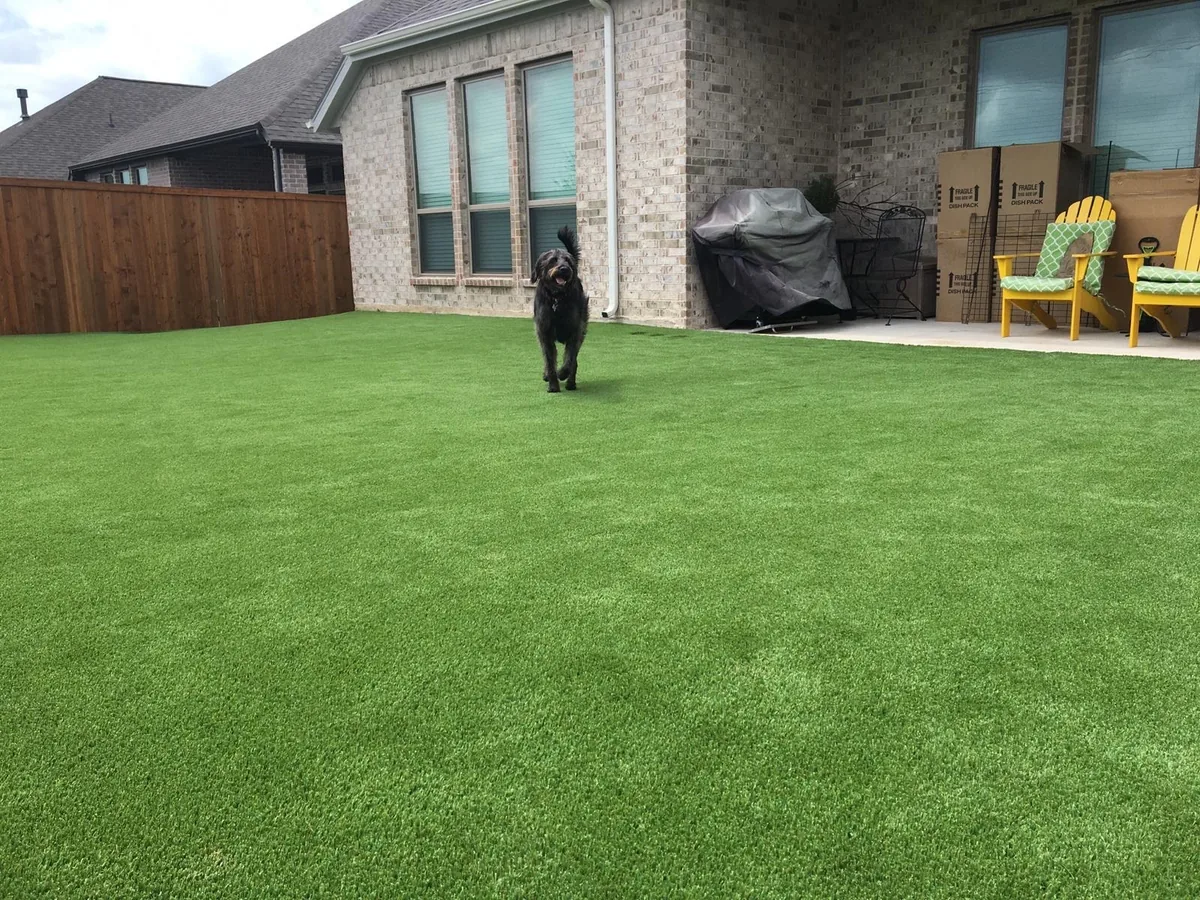
Short answer
The best artificial turf for dogs tends to be one with a backing that drains across its whole surface, over a stone base graded to carry water away. Much of the ground around Keller is slow-draining clay, so the base tends to matter as much as the turf. An infill sold for pet odor and regular rinsing can help too.
The best artificial turf for dogs is chosen for how it drains, and softness and color can come second. If you are pricing artificial grass for dogs in Keller, the first thing to settle is whether it will smell by August. It can, and most of that gets settled before the turf shows up, in the backing, the base and the infill. After that it comes down to how often you rinse. Any installer quoting your dog run should be able to talk you through each of those.
Start with the backing: how fast does urine get through?
Flip a turf sample over. Many lawn products have a solid coated backing with drainage holes punched every few inches, and those tend to work reasonably well for rain, which falls across the whole surface and has plenty of holes to find. A dog tends to go on the same small patch every morning, so whatever lands between the holes can sit in the fibers and warm up.
Products aimed at pets often use a backing that drains across its whole surface, sometimes called flow-through or fully permeable. Ask for the drainage rate on the spec sheet, usually given in inches per hour, and compare it between the products you are offered. We are leaving brands out of this because the lineups change. The rate gives you a way to compare products, and it is fair to ask how it was tested. If an installer cannot tell you how fast the backing drains, ask them to find out before you sign.
Why does the base under the turf matter so much?
A fast backing drains onto whatever is beneath it. Much of the ground around Keller is clay, which tends to drain slowly, so water can sit under the turf for a while. We put a compacted stone base under our turf for that reason, and on a dog run it should be graded so the low edge sends water toward a bed, a gravel strip or a drain and away from the patio.
Some installers add a drainage pad between the stone and the turf for pet areas, to help liquid move sideways and dry faster. It costs more and may not be needed on every run, so ask whether it makes sense on a flat yard with heavy clay. Odor tends to come from moisture that stays put, so anything that helps water leave faster is likely to help with the smell.
How do the infills sold for pet odor differ?
Infill is the granular material brushed between the blades to help them stand up. Plain silica sand is cheap and common in lawns, but urine residue can build up between the grains and be hard to rinse out, so it is often passed over for dog runs. We can talk through the infills sold for pet odor and choose what suits your dogs and the space.
Mineral infills, the zeolite family, are sold to hold ammonia until rain or a good rinse flushes it out. Coated sands are designed to shed liquid, and some carry an antimicrobial treatment. A few products are sold as infill-free for pet zones and rely on dense fibers instead. Whichever you look at, ask to see the test data behind the claim, and keep in mind that all of them depend on the drainage underneath. A run built on a base that holds water is likely to smell whatever infill is in it.
A rinsing routine for a Keller dog run
Pick up solids daily, as you would on grass. Then hose down the spots your dog uses every few days in the hottest weeks, and less often when it cools off, since warm weather tends to make the ammonia smell worse. A deeper rinse now and then, starting from the high side of the run, can help carry residue through the infill and out the low edge.
Keller keeps a twice-weekly watering schedule and bans outdoor watering between 10 a.m. and 6 p.m. year-round, even on allowed watering days. Ask the city how its current rule applies to a hand-held hose, and keep your rinsing to early morning or evening in the meantime.
For a spot that lingers, a turf-safe enzyme cleaner can help if you let it soak in, since the odor tends to sit down in the infill and backing. Bleach is generally best kept off turf fibers.
Heat is worth planning for too. Penn State's sports surface researchers found a synthetic sports-field plot ran far hotter than unwatered ryegrass in June sun, and the American Kennel Club's hot pavement advice is to walk dogs in the early morning or evening in hot weather. Our post on whether artificial turf gets too hot in Texas has the measured numbers and a way to check the surface before the dog goes out. A shaded run is likely to help more than a hose.
What does a dog run need, and what should you ask the installer?
A good run tends to have a slight fall to one edge, a hose bib within reach, a gate the dog cannot nose open, and afternoon shade from a fence, the house or a tree. For a dog that likes to run the fence line, length often helps more than width. Our page on Keller pet turf for dog runs has more on layout, and the short answer is to follow the route the dog already wears.
Before you sign, get answers to these. What is the backing's drainage rate? How deep is the stone base and how is it graded? Where does the water go when it leaves the run? Which infill, and why that one for dogs? And how will the edges be pinned along the fence? Good answers should give you a fair idea of how the run is likely to hold up. Our pet turf cost guide has some rough arithmetic on what a run can cost, and we quote runs in Colleyville and the other towns around Keller.
Frequently Asked Questions
What infill is best for dog urine on artificial turf?
Look for one sold for pet odor that drains well. Mineral infills in the zeolite family are sold to hold ammonia until rain or a rinse flushes it out, and coated sands are designed to shed liquid. Plain sand can collect residue between the grains. Any of them depends on a base that drains.
How often should I rinse pet turf in a Keller summer?
Hosing down the spots your dog uses every few days in the hottest weeks is a sensible starting point, with a deeper rinse now and then. Keller bans outdoor watering from 10 a.m. to 6 p.m. year-round, so check the current rule with the city and keep rinsing to early morning or evening.
Why does my artificial grass smell worse after rain?
Rain can re-wet dried urine residue in the infill and backing, and that can release the ammonia smell. It often means liquid has been sitting where it should be draining through. A deep rinse and a turf enzyme cleaner may help for a while. If it keeps happening, have someone check the base and backing.
Is artificial grass safe for dog paws in Texas heat?
In afternoon sun it can get hot enough to burn paw pads, so plan for it. Put the run where the house, a fence or a tree throws afternoon shade, and keep summer bathroom trips to morning and evening. Our post on turf heat explains how to check the surface with your hand first.
Ready to Get Started in Keller?
Keller Artificial Turf Works serves Keller and the surrounding area. Send a few photos of your yard and we'll reply with a written quote.